
Jo Coxhill is a former marketer, turned workplace consultant, and a passionate advocate for mental health. Her mission is to ‘make work not suck’ – something we can all get behind!
Jo founded Vision 29, a company that works with CEOs and business leaders to build healthy and engaged workplaces and teams. We got talking about burnout, the bosses who make the biggest difference, and what it really takes to feel well at work. If you’ve ever felt completely stressed and worn out, I think you’ll get a lot out of what Jo has to say.
Jo – it’s good to see you again. First off, I love your mission to ‘make work not suck’. What motivated you to go on this mission?
My very first job, many years ago, was working for a tech company. I had an amazing boss who created an awesome culture where we all felt empowered, valued and inspired to work well together. I was there for 14 years and assumed every company was like that. But as I moved on to different roles and companies leading global marketing teams, I soon realised the world of work isn’t always like that. There are controlling and micro-managing bosses, as well as toxic cultures. After several negative experiences, I wanted to make a change. I decided to start my own business to help people so they don’t have to suffer in silence at work.
You seem to have a way with words from your marketing background. What’s the story behind your company’s name Vision 29?
I get asked that a lot. My vision for my business was to help people with their company culture and to build myself a more flexible way of working. Vision was about looking forward. I also knew I had to have 29 in it because it’s my birthday and lucky number.
What trends are you seeing right now in how burnout is showing up in the workplace?
I did a webinar on this where I talked about how we’re addressing the wrong problems when it comes to people at work. Recent data from Poppulo, a company that runs employee communication tools, showed that in the last 12 months, 65.8 million messages on wellness were sent to employees on their platforms. Wellness was the second most communicated theme after leadership communications. When you break that down, that’s about 5.7 million messages a month and 188,000 messages a day being sent on wellness. Yet despite this, employee burnout continues to be on the rise. Companies are communicating surface-level things like their employee assistance programmes and tools to help you sleep, eat and exercise better to support your wellbeing. But those aren’t dealing with the core issues, which is the culture of the business. Its values, behaviours and leadership styles. Burnout is created through the way we work and what is being role modelled to us.
Why do you think so many people accept burnout as part of the job?
Burnout is starting to become the norm. The pressure to deliver when everything is a priority. We don’t spend enough time celebrating successes or even saying thank you. With many people working from home now, remotely or hybrid, you’re also always ‘switched on’ and not putting enough boundaries around your own wellbeing. When everyone around you is working that way and you don’t feel supported, it’s hard to push back. Leaders can do a lot to change that by role modelling the right behaviours. The aim should be to work for a company where you feel aligned with your leaders, their goals, purpose and behaviours. That’s how you know you’re going to give and feel your best at work.
How can leaders support mental health without it just being a tick-box exercise?
I recently spoke on a panel with business leaders who shared real-life examples and success stories of improving wellbeing in their companies. What stood out was that these leaders didn’t just talk about wellbeing, they lived it. They actively role modelled the behaviours they wanted their people to embrace. One panellist described how their company shifted from simply broadcasting messages about wellbeing, to truly connecting with their people. A simple but powerful example was encouraging employees to take regular breaks. If a meeting was cancelled, for instance, they suggested using that time for a walk instead. This approach evolved into a company-wide global steps challenge, led by a senior leader, that collectively reached an incredible 55 million steps. The key was intentionality, walking the talk (literally), and showing that wellbeing wasn’t just a policy, but a practice.
What are the top signs that a company’s culture is quietly draining its people?
It often starts when you see people begin to withdraw or as we call it, ‘quietly quit’. Employees start to do the basics rather than striving to do more and go above and beyond. A key sign of this behaviour is in meetings, they begin to speak, engage and contribute less. You may also start to see the quality of their work begin to slip, small mistakes sneaking in and projects not delivered on time. Finally, a tell-tale sign is if your high performers begin to leave. They’re usually the ones with options so will be the first out of the door.
You’ve helped build cultures where people thrive — what does a truly thriving workplace look and feel like from the inside?
It’s one where good leaders build trust and empower their people. They give you the freedom, flexibility and autonomy to do your best work. They act as a coach and a sounding board when you’re not sure how to approach something. But they encourage you to try new things, knowing that if you do mess up, and the stakes aren’t high, it’s not the end of the world. There’s that psychological safety. They’ll still support you and make sure that together lessons are learned. It’s that co-creation mindset of ‘we’re all in this together’. For example, during the COVID-19 pandemic, I worked with a leader, where at their company All Hands, he initially got a lot of questions being asked anonymously. Some of the questions were often very hard hitting too. But he took the time to answer every question as honestly as he could. Even the ones where he didn’t know the answer. He responded with, ‘I honestly don’t know’ or ‘I’ll get back to you on that’. Over the months, the number of questions asked anonymously went down and more people felt comfortable putting their names to their questions. That’s because he’d built up their trust, and a safe space to voice their thoughts and ideas together. That’s a great example of how good leaders show up for their people. It’s a collaboration and setting a clear purpose and direction of how you’ll pull through together, even in the toughest moments.
What do leaders acting on employee feedback really look like in practice?
Listening to your people is important. I tell my clients we can’t do anything until we’ve listened to your employees, and they’ve had a voice to shape what you’re trying to achieve. Whether through annual surveys, polls or interviews. It’s hard for leaders to argue with facts. It’s also about observing their workforce as that can tell you a lot. But you have to have leaders who are fully invested and in tune, or emotionally connected. Those who see their people as the heartbeat of their organisation and are ready to invest in them and themselves. Others view it as an unnecessary investment, as they have financial performance metrics to meet. But it’s your people who help you achieve those goals. You can’t just focus on the numbers and neglect the people side of your organisation.
What’s a powerful story you’ve come across of how a company’s changed its culture and how it operates?
In 2020 after the murder of George Floyd, I worked with a company on their equity, diversity and inclusion initiatives. Most of their leaders at the time were white males and they openly admitted that they didn’t feel equipped. So we ran sessions inviting employees to come and share their stories. I still get emotional thinking about it. We captured powerful stories, some which were filmed with their permission, and we turned them into an employee campaign called ‘This is Me’. The campaign helped shape their company culture by getting a better understanding of how discrimination affects minority and disadvantaged groups. The company culture transformed, and they’ve recently started an employee podcast sharing more people stories and topics. That was an authentic and beautiful way to make a difference.
Finally, any favourite books or podcasts you’d recommend on workplace culture, mental health or burnout?
Some of my favourites are:
- You are enough: embrace your flaws and be happy being you by Cheryl Rickman – I’d recommend this to anyone going through burnout like I did many years ago. It covers letting go of perfection, not comparing yourself to others and embracing what makes you, you.
- The rest revolution: how to reclaim your rhythm and conquer burnout when overworking has become the norm by Amanda Miller Littlejohn – also a great book on burnout and how to recover from it.
- Remote not distant: design a company culture that will help you thrive in a hybrid workplace by Gustavo Razzetti – I love this book. It has many actionable tips companies can use to carry out remote working effectively.
- Monetising the employee experience: how to prove the ROI for investing in your people and unlock lost productivity by Mike Sharples and Nicholas Wardle – this is a beautifully designed book with tools and graphs to develop a winning employee culture.
- The culture whisperer – a podcast for HR, Communications, and Business Leaders everywhere by Dawn Smedley – I love the people she has on her podcast: CEOs, HR leaders and Communication experts having inspiring and uplifting conversations.
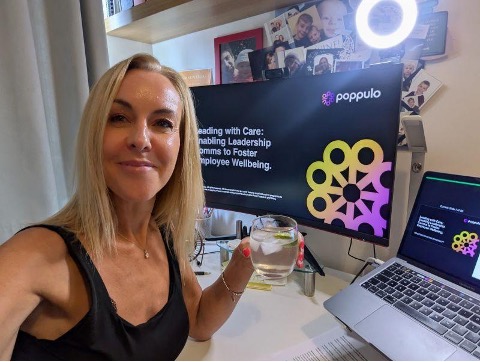
Thanks, Jo. And I’ve loved our conversation!
Jo is a consultant for businesses across industries who helps them improve their performance and profit, by creating happy, healthy and engaged teams through the power of employee voice.
Find out more about Jo and her mission to ‘make work not suck’.
I loved this conversation. Thank you for having me and bringing thi hugely important topic to light.
Thanks for taking the time Jo – you dropped so many great nuggets!